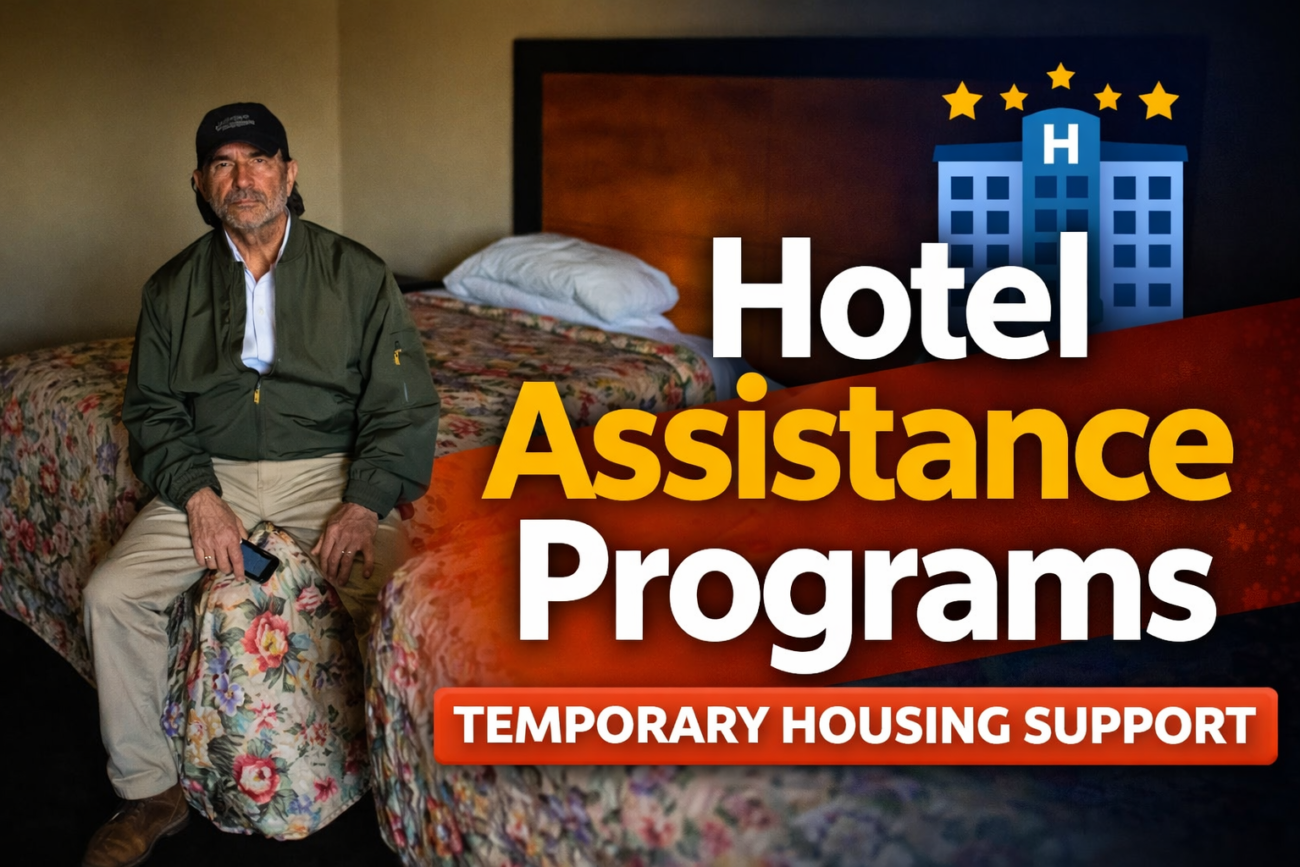
Emergency hotel assistance and temporary housing vouchers are distributed primarily through localized networks of community action agencies, non-profit charitable organizations, and local social services departments, rather than through direct federal distribution. To obtain immediate temporary housing support, individuals typically must turn to regional access points that assess urgency, household vulnerability, and the availability of funds.
Charitable and Religious Organisations offer Hotel Assistance Programs
The Salvation Army
The Salvation Army’s emergency hotel voucher program offers short-term stays in hotels or motels for individuals and families facing an immediate crisis—specifically in cases where the Salvation Army’s physical emergency shelters are at full capacity, are unavailable in the local area, or cannot safely accommodate the applicant. Rather than operating as a universal federal resource, this hotel assistance functions through localized allocations of discretionary funds, managed by community social workers.
Eligibility Criteria
To qualify for a short-term hotel voucher, applicants must demonstrate an urgent and immediate need and fall into specific high-priority categories:
Verifiable Crisis: Rapid displacement due to a recent eviction notice, domestic violence, sudden job loss, or a localized natural disaster.
Lack of Alternative Shelter: The Salvation Army’s local physical shelter facilities must be at maximum capacity, or the household must have safety needs that a community shelter cannot adequately address.
Priority Demographics: High priority is given to single parents with minor children, pregnant women, seniors, and individuals with severe medical vulnerabilities or physical disabilities.
Sobriety and Compliance: Beneficiaries are required to sign an agreement pledging to completely abstain from drug and alcohol use during their stay, as well as to comply with all facility rules.
Required Documentation
If an intake appointment is approved for an applicant, they will typically be required to present physical proof of their identity and their crisis situation to a case manager:
Official Photo Identification: Required for all adult family members who will be residing in the room.
Proof of Crisis: A formal eviction notice, a police report (in cases of domestic emergencies), or a disaster verification document.
Proof of Income or Financial Hardship: Recent bank statements or documentation of enrollment in public assistance programs to demonstrate the existence of a severe financial shortfall.
Use the Salvation Army Location Finder or visit SAHelp.org to enter your zip code and connect directly with the specific social services office that serves your neighborhood.
Catholic Charities
Catholic Charities’ emergency hotel voucher programs provide temporary, short-term lodging for vulnerable individuals and families experiencing sudden housing displacement or undergoing a severe crisis. Since Catholic Charities USA operates as a decentralized network comprising over 160 local diocesan agencies, hotel assistance programs rely entirely on local grant funding, regional partnerships, and seasonal demand driven by weather conditions.
Unlike a standardized government entitlement program, Catholic Charities implements emergency lodging through three primary local frameworks:
Response to Seasonal Weather Conditions: Many regional offices activate hotel voucher programs specifically during extreme weather conditions—such as severe winter freezes or summer heatwaves—when traditional overnight shelters reach maximum capacity.
Disaster Relief and Humanitarian Respite: In the event of localized natural disasters (floods, fires) or sudden humanitarian emergencies, select regional offices establish specific funds to cover hotel rooms as a direct, transitional housing solution.
Eviction Prevention and Discretionary Funds: When an individual or family faces sudden displacement and no beds are available in physical shelters, case managers may utilize flexible financial assistance grants to cover a multi-night stay at a motel.
How to Apply for Assistance and Initiate Contact
Use the official Catholic Charities USA Agency Finder to locate and call the central office assigned to your specific diocese or county. Many municipal centers require that applications first be processed through the regional 211 Helpline network. By dialing 2-1-1, you are registered with the state as homeless, generating the verified “paper trail” documentation that Catholic Charities requires to authorize emergency funding.
St. Vincent de Paul
The hotel assistance programs of the Society of St. Vincent de Paul (SVdP) are organized primarily around local, grassroots chapters—known as “Conferences”—that operate directly out of neighborhood Catholic parishes. Rather than relying on rigid corporate offices, SVdP employs a unique model of personalized “home visits,” in which trained volunteers meet directly with applicants to assess their financial situation, verify their need, and distribute motel vouchers for short-term stays.
Since funding relies entirely on local parish collections and regional grants, program availability and models vary significantly by location.
How to Apply for Assistance
Referral via Local Parish: The quickest way to locate available funds is to contact a local Catholic church and ask if they operate an active St. Vincent de Paul Conference helpline.
National Directories: You can check regional service boundaries through the SVdP USA portal, or locate specific centers by state—such as SVdP Dallas or SVdP Greater Phoenix—depending on your geographic location.
The 211 Safety Net: If you are unable to locate an operational parish helpline, dialing 2-1-1 remains the primary method for finding out which local Conferences currently have active funding allocations for hotel lodging.
Family Promise
Family Promise’s hotel assistance and temporary housing programs focus exclusively on keeping families with minor children together during a housing crisis. While traditional community shelters often separate families by gender or age, Family Promise utilizes a decentralized network of over 200 local affiliates nationwide to provide private, dignified temporary housing options—including hotel and motel rooms—as part of its core strategies for shelter and homelessness prevention.
How to Apply for Assistance and Contact an Affiliate
Family Promise does not administer a centralized federal fund for direct-distribution vouchers. All resources are managed locally by community-based affiliates.
Locate Your Local Chapter: Visit the official website to access the comprehensive Family Promise Affiliate Directory and find the phone number or intake form for the specific branch serving your county or city.
Expect a Waitlist: Given that these highly specialized family programs are in extremely high demand, local chapters frequently have limited capacity and operate localized waitlists.
The Coordinated Entry Pathway: In many regions, it is not possible to apply directly to the hotel program on your own. You must call your local 211 helpline to complete a county-level homelessness assessment; this assessment subsequently refers eligible families directly to the Family Promise intake team.
Primary Intake and Local Referral Networks for Hotel Assistance
The 211 Helpline Network
By dialing 2-1-1, individuals connect directly with regional resource navigators who maintain real-time databases regarding available emergency motel vouchers, severe weather shelter operations, and vacant housing units.
Community Action Agencies (CAAs)
Local CAAs receive state and federal grants to administer flexible emergency funds, which are frequently utilized in the form of temporary hotel vouchers for families or individuals experiencing sudden displacement.
Coordinated Entry Systems (CES)
Most municipal and county housing departments utilize centralized intake systems to assess households and determine their immediate placement options, their eligibility for rapid rehousing programs, or their access to emergency shelter networks.
Government and Disaster-Specific Support
Local Social Services Departments
County and municipal social services offices administer state-funded emergency financial assistance programs—such as Emergency Assistance for Families with Children—which may, in certain instances, be authorized to cover emergency housing expenses.
FEMA Transitional Sheltering Assistance (TSA)
In the event of federally declared natural disasters, FEMA activates the Transitional Sheltering Assistance (TSA) program, which covers the costs of direct, short-term hotel or motel stays for duly verified disaster survivors.
