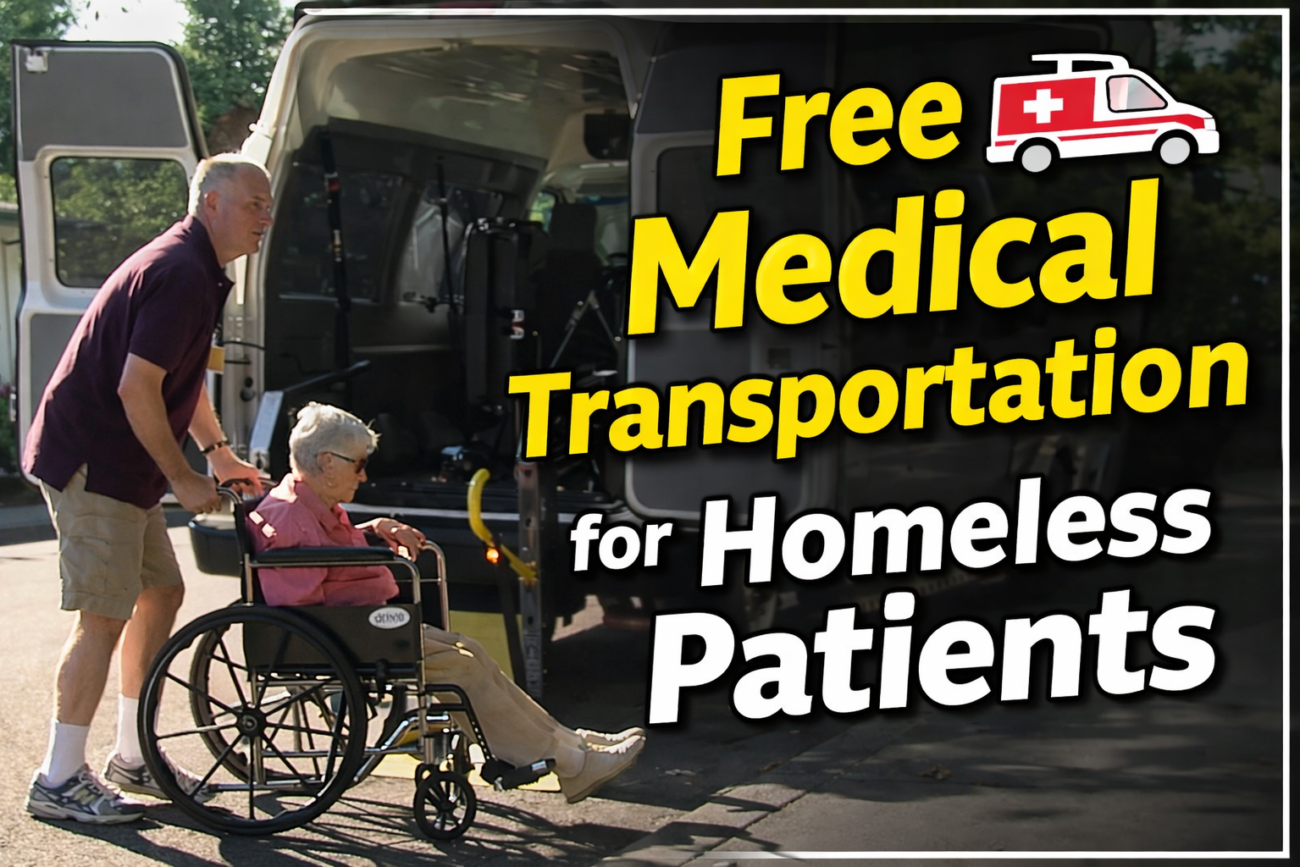
Homeless patients can obtain free medical transportation through Medicaid’s Non-Emergency Medical Transportation (NEMT), national charitable transportation networks, and local assistance programs. Since homelessness often hinders access to reliable transportation, various federal, state, and non-profit programs cover these trips to doctors, dentists, pharmacies, and clinics.
Utilize Medicaid Non-Emergency Medical Transportation (NEMT)
Medicaid’s Non-Emergency Medical Transportation (NEMT) is a federally mandated benefit that ensures Medicaid members who lack reliable transportation can access covered medical appointments, dental visits, therapies, and pharmacies.
Rules for Booking a Trip
Advance Notice: Generally, trips must be booked at least 2 business days (48 hours) in advance for local travel. For long-distance trips outside the local county, 5 business days’ notice is required.
Urgent Exceptions: The 48-hour rule does not apply in cases of urgent need, including immediate hospital discharges, pharmacy prescription pickups, or urgent clinic visits.
Cost-Free Benefit: The service comes at no cost to the patient, although some states require a nominal copay (e.g., $1 to $2).
Information Required When Booking
When calling a broker or the state program, please have the following details ready:
Patient Details: Full name, date of birth, and Medicaid ID number.
Pickup Logistics: Exact address, phone number, and physical limitations (e.g., whether the patient requires a wheelchair lift, space for a walker, or a van-style vehicle).
Destination Details: Name of the medical facility, doctor’s name, full address, phone number, and exact appointment time.
Vehicle Types Provided by NEMT
Brokers assign the most cost-effective vehicle that safely accommodates the patient’s physical and medical capabilities:
Public Transportation: Free bus tokens or subway passes for patients who can walk on their own (fully ambulatory).
Rideshare Services and Taxis: Standard sedan transportation provided through local taxi networks or via agreements with Lyft/Uber.
Wheelchair-Accessible Vans: Specialized vehicles equipped with ramps or hydraulic lifts.
Reimbursement for Fuel Expenses: If the patient—or an acquaintance—has access to a vehicle but cannot afford the fuel, Medicaid can register the individual and pay for the gasoline consumed.
Booking Channels by Region
Since Medicaid is administered at the state level, booking channels depend entirely on how local benefits are delivered:
1. Through State Programs (Fee-for-Service / Traditional Medicaid)
If the patient is enrolled in traditional state Medicaid, make the booking directly through the state’s central Non-Emergency Medical Transportation (NEMT) brokerage system. For example, in Texas, the coordination of transportation services is handled by the Medical Transportation Program (MTP).
Texas MTP Hotline: 1-877-633-8747 (1-877-MED-TRIP).
2. Through Managed Care Organizations (MCOs)
If the patient receives benefits through a private insurance plan under the Medicaid program, the booking must be made through the transportation broker contracted by that specific provider (such as MTM, SafeRide, or Modivcare).
Aetna Better Health (Texas): 1-866-411-8920
Blue Cross Blue Shield STAR: 1-866-824-1565
Superior HealthPlan: 1-855-932-2318
UnitedHealthcare Community Plan: 1-888-462-6050
Contact Ride United (United Way)
United Way manages the Ride United initiative in collaboration with Lyft to help bridge transportation gaps for vulnerable populations.
How it works: They provide free credits for rideshare services specifically intended for medical appointments, food access, and housing services.
How to book: Dial 2-1-1 from any phone. Explain to the 211 referral specialist that the patient is experiencing homelessness and needs transportation to access medical services. They will coordinate or schedule a Lyft vehicle to pick up the patient at their location.
Request assistance through national medical charities
For patients who must travel long distances or who require specialized medical care, there are national charitable organizations that coordinate free transportation:
Mercy Medical Angels
Mercy Medical Angels offers free, long-distance medical transportation nationwide for patients who cannot afford the travel required to receive specialized medical care. The organization coordinates ground transportation, flights conducted by private volunteer pilots, and assistance with commercial airlines.
Types of Free Transportation Offered
The organization evaluates the distance and the patient’s physical needs to assign the most cost-efficient method of transportation:
Ground Transportation: Free gas cards (for trips totaling (\ge ) 100 miles), commercial bus tickets, Amtrak train tickets, or vouchers for rideshare services such as Uber/Lyft (for local trips ranging from 30 to 70 miles, round-trip).
Private Volunteer Flights: Provided through Angel Flight Mid-Atlantic for trips ranging from 200 to 900 miles. This service utilizes small private aircraft and covers 11 states: Virginia, Maryland, West Virginia, Pennsylvania, Tennessee, Kentucky, North Carolina, Delaware, Michigan, Ohio, and Washington, D.C.
Commercial Airline Flights: For long-distance trips exceeding 475–900 miles. The charity covers the cost of the ticket on major commercial airlines, although patients may be required to pay minimal airline taxes or government fees (typically between $25 and $50).
Eligibility Requirements
To qualify for assistance, the patient must meet the following five criteria:
Medical Need: Travel must be strictly for the purpose of receiving a verified medical diagnosis, treatment, or clinical follow-up care.
Financial Need: Household income must be at or below 300% of the Federal Poverty Guidelines (or up to 400% for veterans, through their “Angel Wings for Veterans” program).
Distance Barriers: The destination facility must be located outside the patient’s local area (generally a minimum distance of 50 miles one way, or totaling more than 100 miles per month).
Ambulatory Status: The patient must be medically stable, capable of walking with minimal assistance, and able to remain seated upright with their seatbelt fastened. Medical care or oxygen monitoring cannot be provided during the trip.
Advance Notice: Initial booking requires a minimum lead time of 7 to 10 days prior to the appointment. Requests may be accepted up to 45 days in advance.
Required Documentation for Application
To submit a request, you must upload official verification documents online:
Appointment Verification: A letter, a screenshot from a patient portal, or an email confirmation explicitly displaying the patient’s name, the physician’s name, the medical facility’s details, and the date/time of the appointment.
Proof of Income: A copy of the household’s most recent federal tax return, an SSI/disability benefits statement, or an EBT/SNAP enrollment approval letter, accompanied by bank statements from the last 3 months. Pay stubs or W-2 forms are not accepted on their own.
How to Apply
Applications must be processed directly online, or by phone for urgent requests:
Online Forms: Submit a request (the process takes 10–15 minutes) via the official Mercy Medical Angels travel request page.
Urgent Requests: If the appointment is urgent or scheduled to take place in fewer than 7 days, do not submit the request online. Instead, call their coordination line directly during standard business hours at 1-800-296-3797.
American Cancer Society
The American Cancer Society (ACS) offers free medical transportation, primarily through its Road To Recovery® program. This program connects cancer patients who lack reliable transportation options with trained volunteer drivers, who use their personal vehicles to provide free rides to and from treatments.
Patient Eligibility Requirements
Since rides depend entirely on the availability of local volunteers, patients must meet specific medical and safety criteria to qualify:
Appointment Type: The trip must be exclusively for a cancer-related medical appointment (such as chemotherapy, radiation therapy, or oncology check-ups). It does not cover general health screenings or trips to the pharmacy for non-cancer-related reasons.
Ambulatory Status: The patient must be fully ambulatory or capable of traveling with minimal assistance. If the patient uses a cane, a walker, or a wheelchair, they must be able to fold and load the equipment into the vehicle without any assistance. Drivers are legally prohibited from physically lifting or moving patients.
Age Limits: Patients must be 18 years of age or older to travel alone. Patients under 18 must be accompanied by a parent or legal guardian on every trip.
Medical Restrictions: The patient cannot be actively under the effects of deep anesthesia or sedation at the time of pickup. Additionally, due to safety regulations for volunteer drivers, patients emitting medical radiation (resulting from specific internal treatments) will not be able to use this program until authorized by a physician.
How the Program Works (Roundtrip App)
The American Cancer Society (ACS) partners with the digital medical transportation platform Roundtrip to manage booking logistics.
Once registered, you can track your trip request via a smartphone app or through a web portal on your computer.
You can book one-way trips, standard round trips, or schedule recurring trips if you have a fixed treatment schedule (daily or weekly).
The app sends automatic notifications (via text message or within the app itself) the moment a local ACS volunteer accepts your trip request.
Step-by-Step Booking Process
Step 1: Gather Information: Have the patient’s full name, the address of the treatment center, the exact appointment time, and the oncologist’s contact information close at hand.
Step 2: Submit Your Request in Advance: Trips must be requested between 25 hours and several business days in advance. Booking further in advance increases the likelihood that a volunteer will accept the route.
Step 3: Call or Check Online: To verify if the program is operational in your specific zip code, call the ACS helpline directly (available 24/7) at 1-800-227-2345. You can also search for active regional programs on the American Cancer Society’s “Road to Recovery” portal.
Alternative Transportation Subsidies
The availability of volunteer drivers may be limited in certain rural or high-demand regions. If there are no active “Road to Recovery” volunteers in your area, the ACS often provides transportation subsidies directly to local health systems and hospitals. Ask the hospital’s oncology social worker or patient navigator if they have access to ACS-funded transportation funds, commercial taxi vouchers, or local public transit passes.
Are you consulting this resource for yourself or for a patient? If you share the pickup location’s zip code, I can check if there are volunteer drivers actively operating in that area or help you access alternative funding for cancer patient transportation.
Take Advantage of Local Shelters, Clinics, and Street Medicine Teams
Many local organizations directly manage logistics for people experiencing homelessness:
Federally Qualified Health Centers (FQHCs): Local “Health Care for the Homeless” clinics often operate their own transport vans or provide free bus tokens to patients.
Street Medicine Teams: Mobile medical units provide care directly on the street, completely eliminating the need for transportation.
Shelter Case Managers: Most emergency shelters have discretionary funds or dedicated transportation networks available to transport residents to their medical appointments.
