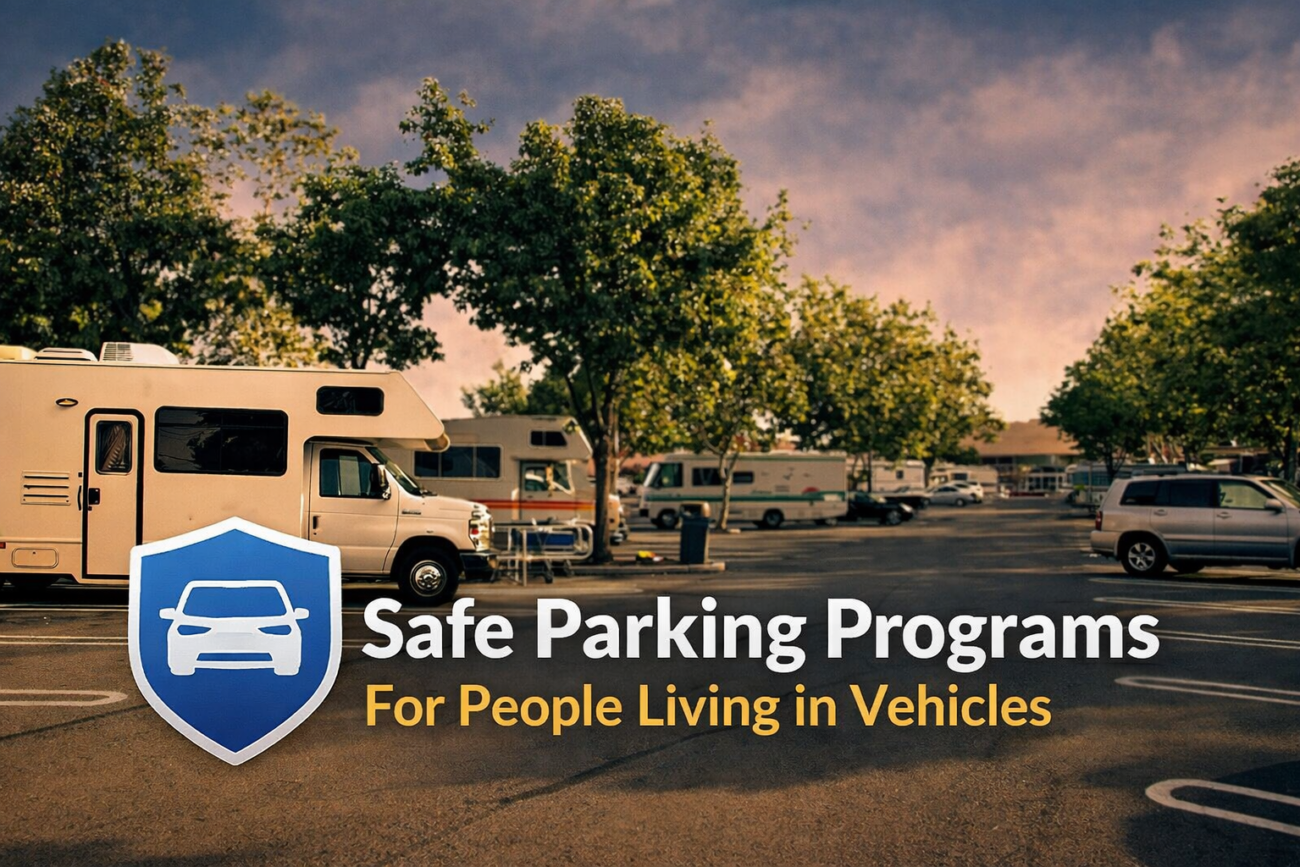
Safe Parking Programs offer a safe, legal place for individuals and families living in their vehicles to park and spend the night. Beyond providing a physical space, these supervised lots reduce the risk of harassment, vehicle towing, and fines, while facilitating vital pathways to permanent housing solutions.
Services offered by Safe Parking Programs
Most organized programs offer more than just a parking spot:
Basic sanitation facilities: Access to clean restrooms, hand-washing stations, and sometimes showers or potable water.
On-site security: These supervised spaces typically feature security personnel, lighting, fencing, or established check-in times to ensure community safety.
Case management: Connections to social workers who assist with housing applications, employment resources, and public benefits.
Vehicle and documentation assistance: Help resolving issues related to expired vehicle registration or driver’s licenses, as well as covering repair costs.
Basic Enrollment and rules
Since these spaces are located on private, civic, or religious organization properties, they are usually governed by specific rules:
Admission requirements: Most locations require a prior application, background check, or intake interview.
Vehicle requirements: Vehicles generally must be in working order. Policies regarding recreational vehicles (RVs) vary significantly by site and size restrictions.
Code of conduct: Sites strictly enforce quiet hours and zero-tolerance policies regarding weapons, drugs, or alcohol.
Regional Safe Parking Programs
If you are seeking local assistance, several major organizations manage safe parking networks:
Los Angeles County, California
The Los Angeles County Safe Parking Program offers safe, legally authorized overnight parking spaces—complete with on-site monitoring and basic restrooms—for individuals and families living in their vehicles. Administered by the Los Angeles Homeless Services Authority (LAHSA) in collaboration with specialized local non-profit organizations, the program provides a stable environment and connects homeless residents with permanent housing networks.
Key program providers and contact information
To secure a spot, you must apply directly to the designated agency managing your area:
Safe Parking LA (SPLA): The largest specialized non-profit organization operating a network of safe parking lots throughout the City and County of Los Angeles (including locations in Hollywood, Koreatown, West LA, and the San Fernando Valley).
How to apply: Complete the interest form on the Safe Parking LA client intake portal or call their dedicated service line at (323) 210-3375 (extension 1) during regular intake hours.
HOPICS (Homeless Outreach Program Integrated Care System): Serves South Los Angeles. Due to recent budget cuts, availability is very limited, and some locations are scaling back operations.
How to apply: Email safeparking@hopics.org or visit their main intake center located at 5715 S. Broadway, Los Angeles, CA 90037, Monday through Friday between 8:00 a.m. and 2:00 p.m.
The Shower of Hope / End Homelessness: Manages select locations focused on providing overnight safety alongside enhanced community hygiene facilities.
How to apply: Contact them via The Shower of Hope portal.
Watts Labor Community Action Committee (WLCAC): Operates parking lots in the Watts/South Los Angeles area with capacity for larger vehicles.
How to apply: Contact them via the official WLCAC website.
Mandatory rules and eligibility criteria
Regardless of which organization operates the parking lot, participants must adhere to strict basic rules to maintain their enrollment:
Vehicle condition: Your vehicle must be in good working order and roadworthy. You must be able to drive the vehicle to enter the lot during the designated evening arrival time and remove it from the premises each morning (typically between 6:00 a.m. and 7:00 a.m.).
Required documentation: The vehicle owner must have a valid driver’s license, current auto insurance, and up-to-date vehicle registration.
No walk-ins allowed: For safety reasons, safe parking locations are kept confidential and are not publicly listed. You cannot show up at a safe parking site to request a spot without a verified referral from a social worker or case manager.
Note: If your documentation has expired, Safe Parking LA case managers can sometimes offer financial aid or document assistance after enrollment to help you settle outstanding payments.
Restrictions for Recreational Vehicles (RVs) and large vehicles
If you live in an RV, camper, or fifth-wheel trailer, finding a spot is considerably more difficult. Most standard safe parking sites only have the physical space or local permits suitable for conventional cars, SUVs, and vans.
WLCAC and The Shower of Hope manage a few specific sites set up to accommodate RVs, though the maximum length limit is usually 20 feet (approx. 6 meters).
If your RV does not fit in standard parking sites, submit your exact location coordinates via the Los Angeles Homeless Outreach Portal (LA-HOP) so that county mobile outreach teams can come directly to your vehicle and offer specialized services.
Warning: Please note that public funding for these programs is undergoing significant changes. Although the Los Angeles City Council voted to maintain several city-run safe parking sites, the Los Angeles County Board of Supervisors reduced county-level funding for the fiscal year. As a result, some specific sites in South Los Angeles and Compton, managed by HOPICS, are facing imminent closure. Always contact the provider or call 211 directly to verify if a specific site remains open.
San Diego, California
San Diego’s Safe Parking Program offers safe, legally authorized locations for overnight parking, providing 24-hour options, basic sanitation facilities, and case management to help individuals and families transition to permanent housing. The program is primarily funded by the City and County of San Diego and is operated by specialized local non-profit organizations.
Key program providers and contact information
To secure a spot, you must complete an intake assessment directly through one of the designated operating agencies. Showing up without an appointment is strictly prohibited, and parking locations are kept confidential for the safety of participants.
Jewish Family Service of San Diego (JFS): JFS is the region’s largest operator, managing four distinct parking lots within the City of San Diego. This includes lots offering 24-hour service and locations specialized for overnight stays.
How to apply: Complete the online intake form via the Jewish Family Service Safe Parking Portal or call their dedicated intake line at (858) 637-3373.
Dreams for Change: Manages several safe overnight parking lots within San Diego city limits, focusing on individuals and families who are employed or seeking employment.
How to apply: Complete the assessment application on the Dreams for Change Safe Parking webpage or call (619) 496-4113.
City of Chula Vista (South County): For individuals in the South Bay area, the City of Chula Vista funds a safe parking program on a municipal lot, managed in partnership with local service providers.
How to apply: Contact the Chula Vista Housing Authority or call (619) 691-5047 to initiate a referral.
City of El Cajon (East County): El Cajon operates a local program designed specifically for families and individuals with operable vehicles registered in East County.
How to apply: Contact the El Cajon Housing Division or dial 211 to request a referral to the East County homeless assistance team.
Key services offered
24/7 Operation: Some JFS parking lots allow participants to remain parked during the day, eliminating the need to leave the site each morning.
Hygiene facilities: All active sites feature clean restrooms, hand-washing stations, and regular access to showers.
Basic needs: Parking lots offer charging stations for electronic devices, and some sites have communal kitchens or serve hot evening meals.
Mandatory rules and eligibility criteria
Vehicle requirements: Your vehicle must be in good working order. You must possess a valid driver’s license, current auto insurance, and up-to-date vehicle registration.
Recreational Vehicles (RVs): Standard trailers, truck campers, and large RVs face significant space constraints. JFS operates a dedicated parking lot for large RVs. You must explicitly state the type of vehicle during the initial intake call to verify whether space is available for that type of vehicle.
Background check: Participants must pass a basic sex offender registry screening (in accordance with “Megan’s Law”) to ensure the safety of families using the shared spaces.
Code of conduct: Strict quiet-hour rules are enforced; additionally, carrying weapons or drugs, lighting fires, and consuming alcohol are strictly prohibited on all premises.
Bay Area, California
Bay Area “Safe Parking” programs offer protected, legally authorized zones across several Northern California counties for individuals and families living in their vehicles. Rather than a single regional system, the programs are organized by county and city, offering overnight shelter, basic hygiene services, and case management.
Key program providers by sub-region
To access these parking sites, you must complete an intake assessment directly with the regional operators. Walk-ins or showing up directly at the site are not permitted; exact locations are kept confidential to protect participants.
1. Santa Clara County (South Bay)
Sites managed in San Jose: The City of San Jose funds two main Safe Parking facilities with comprehensive services: one at the Santa Teresa light rail station and another on Berryessa Road. These sites are managed through the city’s Targeted Outreach and Engagement Program (TOEP) and focus specifically on recreational vehicles (RVs) and oversized vehicles, offering security, case management, and two meals a day.
How to access: Referral eligibility is coordinated primarily through the city’s OLIVE (Oversized Lived-In Vehicle) outreach program, which targets occupied oversized vehicles. Contact the city’s Housing Department at safe.parking@sanjoseca.gov.
MOVE Mountain View: Manages seven highly regulated parking sites in Mountain View that offer 24-hour security, restrooms, and case management. The site expansions, including the Evelyn parking lot, are scheduled to operate until June 30, 2026.
How to apply: Submit an application directly through the MOVE Mountain View portal.
Amigos de Guadalupe (San José): Runs the “Safe Park” program, designed for individuals and families living in operable passenger vehicles (cars, SUVs, vans, and pickup trucks). They partner with local YMCAs to provide free access to hot showers.
How to apply: Complete an intake application through Amigos de Guadalupe.
LifeMoves (Sunnyvale and San José): Offers overnight parking spaces for families living in cars. The program provides blankets, food resources, and intensive housing search assistance.
How to Apply: Request space availability via the LifeMoves FindHelp Portal.
2. Alameda County (East Bay)
Alameda County Regional Safe Parking Program: Operates a centralized, 24-hour safe parking system offering monitored spaces, lighting, and case management assistance.
How to apply: Register by calling (973) 315-6000 or via the Alameda County Safe Parking online portal.
City of Oakland Program: Managed by the Interfaith Council of Alameda County (ICAC). This overnight program includes unique support features such as minor vehicle repairs, financial assistance for DMV registration, and periodic access to the “Dignity on Wheels” mobile shower and laundry truck.
How to apply: Request an intake assessment through the Alameda County homeless services and housing network.
City of Fremont: Connects unhoused individuals with a rotating network of five local properties owned by faith-based organizations. Sites rotate hosting duties monthly and are strictly limited to passenger vehicles for single individuals or couples.
How to apply: Initiate an intake assessment by contacting the housing resource center via “Fremont for Everyone.”
3. San Mateo and Sonoma Counties (North Bay and West Bay)
Santa Rosa Safe Parking: Located in Sonoma County, this city-owned site features up to 52 designated spaces for passenger cars and recreational vehicles (RVs). It offers full access to food banks, daily restroom facilities, and permanent housing placement specialists.
How to access: Apply for service through the City of Santa Rosa’s Homeless Solutions office.
Pacifica (San Mateo Coast): Operates a local permit system for on-street parking of oversized vehicles. Participants gain access to private showers, microwaves, and hot meals managed by the Pacifica Resource Center.
How to apply: Apply directly through the Pacifica Resource Center. Basic entry requirements and vehicle rules
To stay at any Bay Area safe parking site, vehicles and drivers must meet the following criteria:
Vehicle mobility: The vehicle must be fully operational and capable of moving under its own power. Inoperable vehicles or those requiring commercial towing are not permitted at standard overnight sites.
Basic compliance: Drivers must pass a basic screening process (which often includes a “Megan’s Law” background check to ensure safety at sites where families reside).
Strict vehicle limits: Standard sites do not accept recreational vehicles (RVs) due to zoning laws and electrical limitations. If you drive an RV, the most suitable entry point is San José’s TOEP/OLIVE program or the managed site in Santa Rosa.
Pacific Northwest
Pacific Northwest safe parking programs offer protected, legally authorized zones in Washington and Oregon for individuals and families living in vehicles due to homelessness. Because these programs are decentralized, services are managed by cities, counties, and local non-profits rather than a single regional authority.
Key program providers by sub-region
To access these spaces, you must complete an initial assessment directly with the regional operators. Walk-ins or showing up directly at the site are not permitted; exact parking locations are kept confidential to protect participants.
King County and Seattle Metro Area, WA – King County Regional Homelessness Authority (KCRHA): The KCRHA oversees funding for county initiatives serving those living in vehicles, referring individuals to local partner organizations based on vehicle type.
How to apply: Check the active regional listings on the KCRHA’s resources page for vehicle residents or call the Crisis Connections helpline at 211.
Urban Rest Stop and Urban League (Seattle): Coordinate safe parking networks within Seattle city limits, prioritizing families with minor children and individuals entering the workforce.
How to apply: Contact the housing division of the Urban League of Metropolitan Seattle.
Homeward Bound (Clallam County / Olympic Peninsula): Operates a specialized safe parking program in Port Angeles for people living in passenger vehicles, offering on-site sanitation facilities and housing-focused case management.
How to apply: Contact the intake office of Olympic Community Action Programs (OlyCAP).
Portland Metro Area and Willamette Valley, OR
City of Beaverton Safe Parking Program: The City of Beaverton partners with local faith communities and non-profit organizations to provide safe parking spaces. The program accommodates passenger vehicles and offers access to clean restrooms, trash disposal, and assistance from housing specialists (housing navigators).
How to apply: Complete the intake application directly on the City of Beaverton’s safe parking portal or call (503) 526-2584.
Multnomah County / Portland Safe Rest Villages: While Portland relies heavily on structured tiny-home villages (such as Multnomah’s Safe Rest Villages), select sites and partner congregations offer authorized vehicle parking spaces managed by the organization Do Good Multnomah.
How to request access: Spaces are assigned strictly via referrals from mobile outreach teams. Submit a request through the Joint Office of Homeless Services or call 211.
City of Eugene “Rest Stops” Program: Eugene permits the use of managed rest areas and overnight parking on certain commercial, industrial, and religious organization properties for passenger vehicles and small campers.
How to request access: Contact the City of Eugene Homelessness Solutions office or partner organizations such as Community Supported Shelters.
Basic admission requirements and vehicle rules
To stay at a Pacific Northwest safe parking site, vehicles and drivers must meet the following criteria:
Vehicle mobility: The vehicle must be in good working order, capable of moving under its own power, and free of major fluid leaks. Non-functional vehicles or those requiring professional towing are not permitted in standard parking lots.
Compliance and screening: You must pass a basic screening process (which often includes a sex offender registry check—”Megan’s Law”—to ensure safety in sites where families coexist).
Strict vehicle limits: Standard passenger vehicle lots do not accept large RVs or fifth-wheel trailers due to local zoning laws, size restrictions, and electrical limitations. If you drive a large RV, you must explicitly state this during the intake process so you can be assigned a site with adequate space and facilities.
General Free Alternatives
When designated safe parking lots are unavailable or full, people living in their vehicles often turn to the following resources for overnight stays:
Crowdsourced apps: Platforms like iOverlander provide information on user-reviewed locations, safety considerations, and legal parking limits.
Highway rest areas: Many state jurisdictions allow vehicles to remain parked for a set number of hours to prevent drowsy driving.
Agreements with commercial establishments: Certain businesses—such as some Cracker Barrel restaurants or participating Walmart stores—often allow overnight parking for self-contained vehicles (those equipped with their own basic amenities). Always check with the establishment’s management to verify local municipal regulations.
